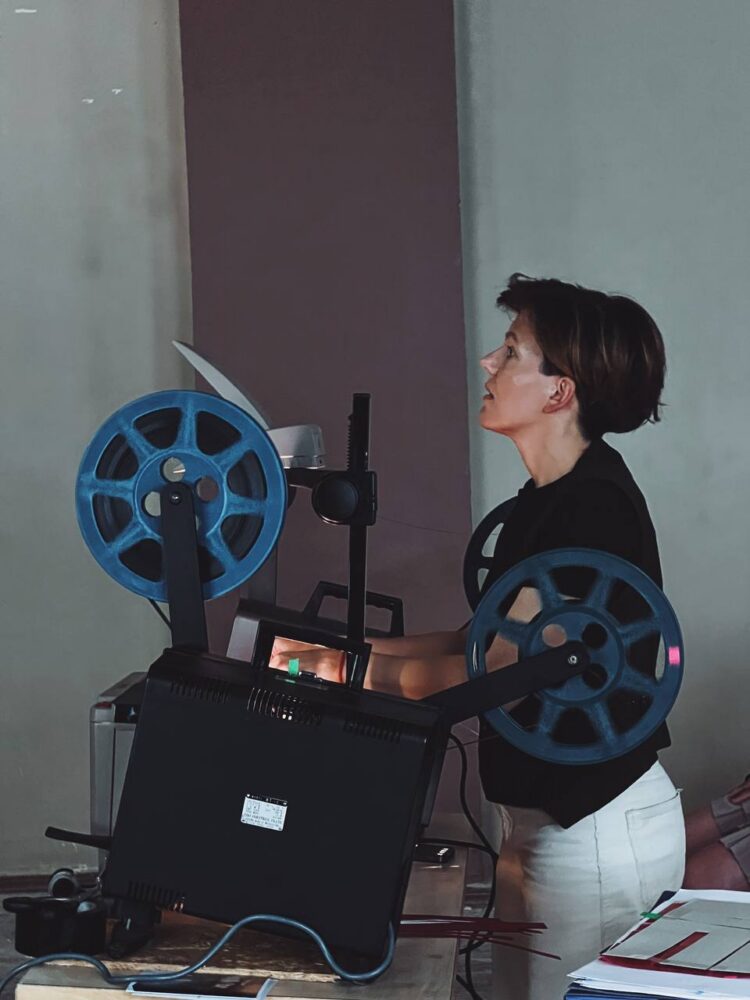
Natalia Kozieł-Kalliomäki stayed at the Narva Art Residency (NART) from 20 April until the beginning of July as part of a project grant awarded by the Finnish Cultural Foundation.
Here is a delightful glimpse into her creative journey at NART, her encounters with Narva, and the unexpected stories she discovered along the way.
We would also like to announce that the new application round of the Finnish Cultural Foundation is now open (10.08–31.08.2026). We encourage Finnish citizens and artists living in Finland to take this opportunity and apply. More info: https://www.nart.ee/en/grants-for-artists-residencies/
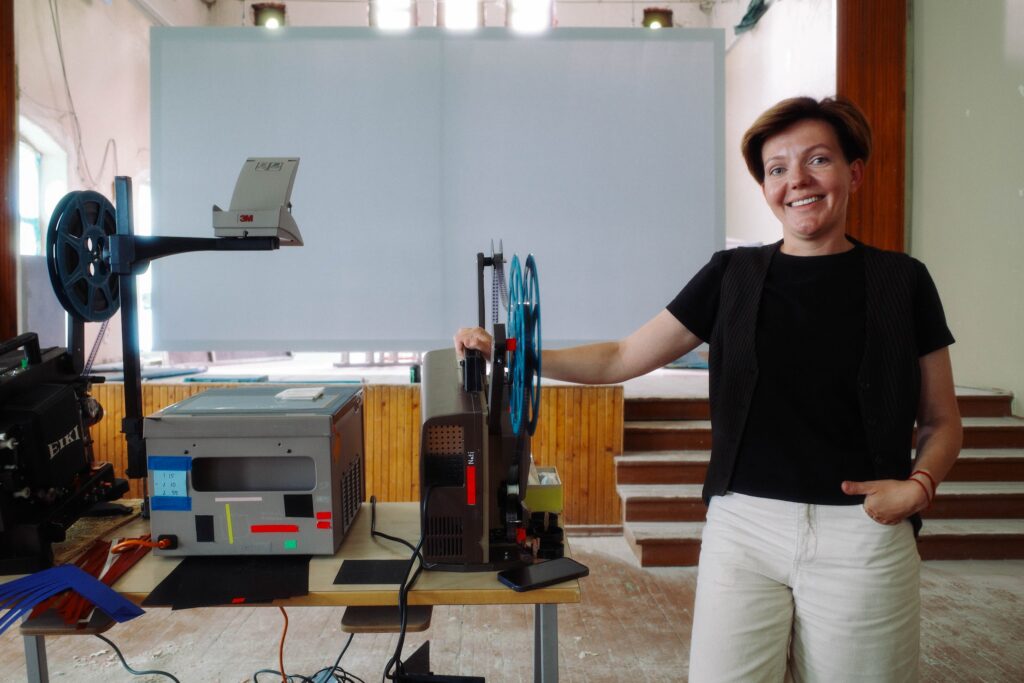
I arrived in Narva carrying what most people would probably describe as far too much stuff. A 16mm Bolex camera. Boxes of black-and-white film. A few film cans containing Estonian travelogues from the 1970s. Naturally, my short favourite experimental films by Eino Ruutsalo, I take them everywhere when I’m heading somewhere unfamiliar. They’re my cinematic icebreakers. Add three 16mm film projectors and an old beloved school-type overhead projector, and suddenly the whole thing starts looking less like luggage and more like a travelling cinema.
Luckily, Narva sits just close enough to Helsinki that my faithful twenty-year-old Renault Twingo managed to haul the entire operation across the border. By the time I arrived, I wasn’t just moving into an artist residency. I was unpacking a portable film laboratory. Like many people, I knew Narva through hot headlines. Border city. Russian-speaking population. Geopolitics. East versus West. But I wasn’t particularly interested in confirming any of that. Cities always have another story to tell if you stop asking them the obvious questions.
I was much more interested in ordinary places. Ordinary people. And one rather extraordinary little cinema hidden inside the old Kreenholm villa, home to the NART residency.
Projection has always been my favourite part of filmmaking. Not because people watch my films, but because, for a little while, strangers sit together in the dark and experience something collectively.
That tiny act of sharing feels increasingly precious. My work revolves around photosensitive motion-picture film, film installations and live expanded cinema performances, borrowing shamelessly from the great city symphonies of the 1920s. Vertov, Ruttmann, early cinema’s simple optical tricks. I still think they haven’t been surpassed. There’s something irresistible about black-and-white film rattling through a projector.
So I came to Narva planning to make a new expanded cinema performance about the city.
The problem is that I never point my camera where people expect.
I’m hopelessly attracted to places that seem to exist just outside everyone’s field of vision. The backs of buildings. Garages. Empty yards. Forgotten corners. Peeling paint. Rust. Cracks. Temporary repairs that somehow became permanent twenty years ago. Things that are worn out, patched together or simply considered ugly tend to become the stars of my films.
When you’ve lived somewhere for years, you stop seeing it. Every city becomes invisible to its own residents eventually. My job, as I see it, was to make familiar places look slightly unfamiliar again.
During three months in Narva I shot an alarming amount of film.
The most fascinating places turned out not to be monuments or “tourist attractions” but housing estates, backyards, garages, playgrounds and little improvised gardens squeezed between apartment blocks. Everything seemed built from limestone dust, weather-beaten metal and decades of practical solutions. But everywhere there were tiny gestures of care. Someone had painted a fence bright green. Someone else had planted flowers into the old rubber tires. Someone had fixed something using whatever happened to be lying around. The city constantly revealed traces of people quietly making their surroundings their own.
Then something unexpected happened.
I became completely obsessed with laundry. Laundry everywhere. Laundry hanging from rusty frames. Laundry stretched between trees. Laundry drying on carpet-beating racks. Laundry outside windows. Laundry beside playgrounds. Sheets. Blankets. Pyjamas. Bras. Tiny underwear. Giant underwear. Lace. Cotton. Floral prints. Duvets. Pillowcases. Basically the entire private life of the city suspended outdoors. And absolutely no embarrassment about it. The best place to dry washing is the sunniest place, after all. Practicality always wins.
The more I filmed, the more I realised that these clotheslines were quietly telling a story of their own.
People often describe Narva as divided between Estonian speakers and Russian speakers. But laundry couldn’t care less. Nobody has ever looked at a bedsheet and thought, “Ah yes, clearly Estonian.”
On the clotheslines there were no borders. Just washing. That became the heart of my project.
Over three months my camera wandered into all sorts of places. Sometimes nobody noticed me shooting it at all. Other times it became an excuse to stop and chat. Rather unexpectedly, Polish turned out to be my secret weapon. Its closeness to Russian opened conversations far more easily than English ever did. English created polite distance. Polish somehow skipped straight to curiosity.
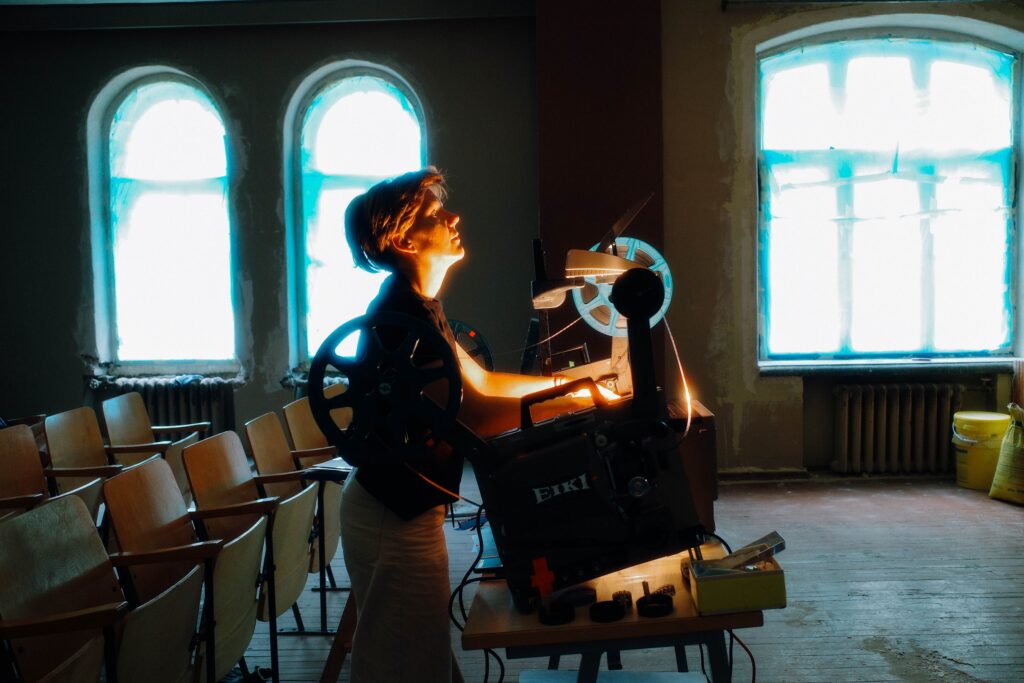
NART gave us enormous freedom to work. Even though the main building and its little cinema spent much of the residency buried beneath scaffolding and renovations, the place never lost its atmosphere. It simply felt like a cinema and the house taking a very long intermission.
Three months later I found myself looking at footage that reminded me of Poland thirty years ago.
Somehow, without planning it, I’d filmed fragments of my own memory.
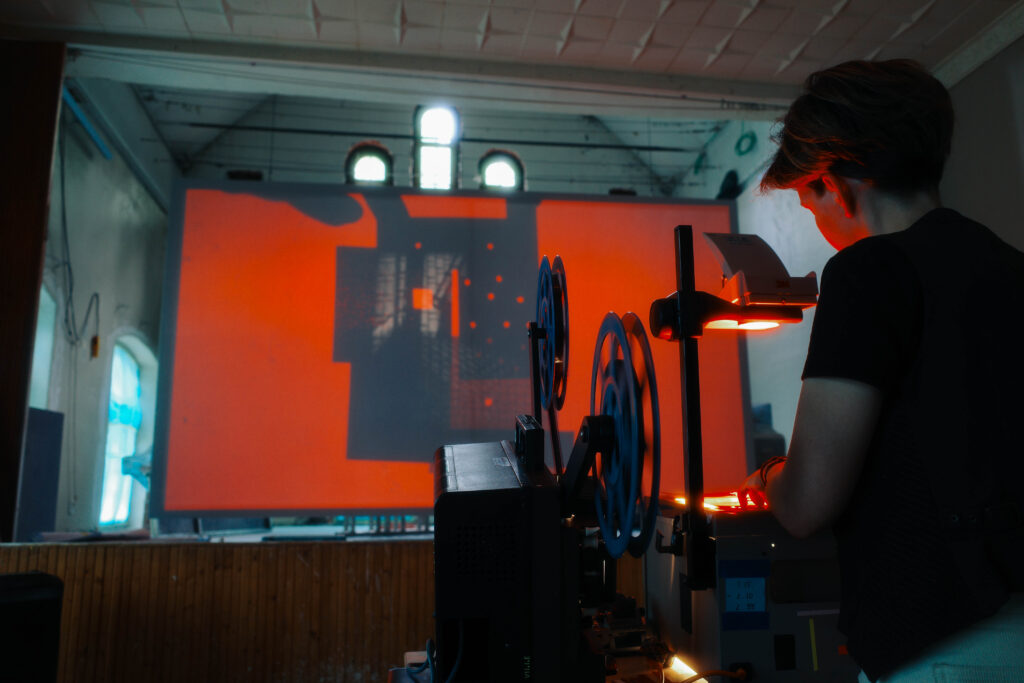
The residency finished with an installation inside the old Kreenholm textile factory. I called it Vis-a-Vis Films were projected onto white shirts and bedsheets hanging from washing lines, so the city’s favourite drying method became my projection screen. It felt only fair.
I met a great reaction from that: some woman came and hug me with almost no words, and some other asked “is this film material from the archive?”
Along the way I also ran several workshops where participants scratched and drew directly onto 16mm film before watching their drawings come to life through analogue projection. No computers. No language needed. Just light, little bit of drawing, clear celluloid and a noisy projector.
One of the nicest things about the residency was meeting Rein, a young artist involved with NART who had been lovingly looking after the tiny projection booth in the Kreenholm cinema. He had exactly the kind of enthusiasm analogue film needs to survive. We spent time together learning the Bolex, developing film and threading projectors. Some knowledge really is easier to pass from one pair of hands to another. We created a tiny, lasting 3min documentary about one of the old buildings in Narva that Rein was crazy about.
When I left Narva, I left one of my projectors behind.
I liked the idea that it could stay there, quietly waiting for the NART cinema to reopen after the renovations. I left it in Rein’s hands, who I already know that started his tiny cinema adventures.
As for me, I came home with hundreds of metres of exposed film.
The residency may have ended, but the work on that material is only just beginning.
Natalia Kozieł-Kalliomäki
August, 2026
Fotod: Mariia Kopytova