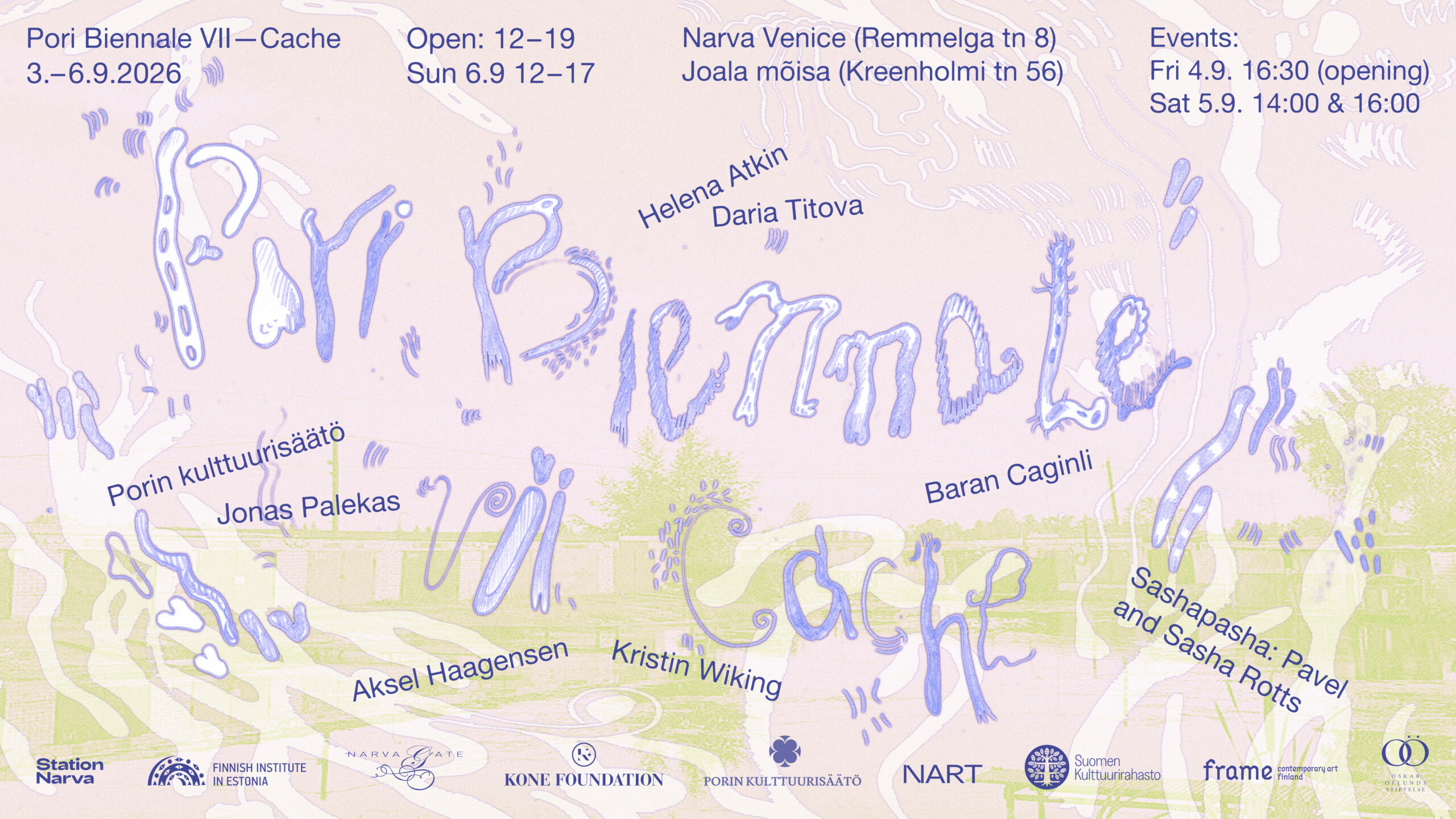
In September the nomadic Pori Biennale takes place in Narva Venice (Kulgu), a striking post-industrial area in eastern Estonia, and imagines what a biennale could be when shaped by local histories, architectures and communities. Continuing Porin kulttuurisäätö collective’s long-term research into the biennial format, the project examines how a biennale might function as a site for co-existence, collaboration, activation and event. Art does not always need grandiose exhibition halls but rather people, who come together around it.
Artists: Baran Caginli (TR/FI), Kristin Wiking (FI/SE), Jonas Palekas (LT), Sashapasha: Pavel and Sasha Rotts (FI), Aksel Haagensen (EE) and Ulvi Haagensen (AU/EE) Cotyledon project: Helena Atkin (UK/EE) and Daria Titova (EE/UA).
Curators: Anna Jensen & Eliisa Suvanto, Porin kulttuurisäätö
Friday 4.09. at 16:30
Exhibition opening
Ingrian Pavilion: Clay. A durational performance by Pavel Rotts
Throughout the opening, the artist hand-builds clay bricks bearing the letters of INGRIA. Gradually, the repeated act of writing transforms language into architecture, assembling the Ingrian Pavilion brick by brick.
Saturday 5.09. at 14:00–16:00
Serving food and baking books. Food event by Jonas Palekas & Baran Caginli
16:00–
Ingrian Pavilion: Boat. A performance by SASHAPASHA.
Six unfired clay bricks spelling INGRIA are lowered into the water on ropes as anchors. As the clay dissolves, the boat returns to shore, where the flag is raised above the pavilion. The performance reflects on migration, memory, and the impossibility of permanently anchoring a place, a language, or an identity.
Pori Biennale VII takes place alongside the music and city festival Station Narva that since 2018 fills Estonia’s easternmost city Narva with music, art, communal gatherings and cross-sector initiatives.
The event is kindly supported by Frame Contemporary Art Finland, Kone Foundation, The Finnish Cultural Foundation, Oskar Öflunds stiftelse, and created in collaboration with NART residency, Station Narva, Narva Gate, and the Finnish Institute in Estonia.
Visual by Daria Titova